Thinking about splitting up a piece of land in King and Queen County? It can sound simple at first, especially if the parcel looks big enough on paper. But in this county, subdivision is a formal land-development process with county review, access rules, health approvals, and plat requirements that can make or break the plan. If you want to avoid costly surprises, it helps to know what the county looks for before you spend money on surveys, engineering, or marketing. Let’s dive in.
Start With the County Process
In King and Queen County, subdivision is not just a matter of drawing new property lines. The Planning & Zoning office administers the county’s land-use policy through the comprehensive plan plus the zoning and subdivision ordinances, and the county’s checklist begins with a pre-application conference.
For minor and major subdivisions, the process typically includes a pre-application conference, application submission, preliminary plat review, notice to adjoining landowners, Planning Commission review, a public hearing, Board of Supervisors action, and a final plat deadline after preliminary approval. The county also notes that the Planning Commission typically meets on the first Tuesday of each month.
That timeline matters if you are trying to coordinate a sale, estate planning, or future construction. Even when a split seems straightforward, you need to allow time for review, revisions, and approvals.
Know Which Subdivision Track Applies
Not every parcel follows the same path. King and Queen County has a simpler review track for certain one- and two-lot subdivisions and for qualifying family subdivisions, but those are still regulated and still require county approval.
The county defines a one- or two-lot subdivision as creating no more than two additional lots or parcels, with review handled by the Zoning Administrator rather than the full minor or major subdivision process. That can be a more manageable route, but only if your parcel meets the standards.
Family subdivisions have their own set of limits and documentation requirements. If your property has been in the family for years, it may be tempting to assume a family transfer is easy, but the county has specific rules about who qualifies, how many lots can be created, and how long the new owner must keep the property before reselling, leasing, or gifting it.
Check Owner Status Before You Apply
Before the county acts on a subdivision request, a few basic issues need to be clean and current. County rules say approval should not be granted if the owner is violating a building code, zoning ordinance, state regulation, or county ordinance.
The county also says approval should not move forward if the owner is delinquent on local taxes. On top of that, county permit fees must be paid in full before the Planning Commission or Board takes action.
This is one of the simplest places to avoid delays. If you are considering a split, it makes sense to confirm taxes, permit status, and any existing code issues before you begin the application process.
Surveys and Plats Matter More Than Many Owners Expect
A subdivision in King and Queen County lives or dies on the details shown on the plat. For family subdivisions, the county requires a Land Development Application, a notarized family subdivision affidavit, and at least four signed and notarized plats or surveys.
The plat must show much more than boundary lines. County materials require boundaries, dimensions, bearings, area, setback lines, street access, zoning district, surveyor’s certificate and seal, owner consent, health approval, drainfield locations, Chesapeake Bay designation information, and the relationship of each grantee to the current owner.
That level of detail is a reminder that subdivision is about whether each new lot can function as a legal, usable parcel. A rough sketch or old survey usually is not enough.
Lot Size Is Only Part of the Story
Many landowners start with acreage and assume a parcel can be split if there is enough land. In practice, the county looks beyond raw acreage to frontage, access, setbacks, easements, environmental constraints, and how much usable area is left for a home site.
County materials for certain one- and two-lot and family subdivision standards say new lots must meet minimum lot sizes of two or three acres, along with either 200 feet or 300 feet of frontage per new lot. Where applicable, a recorded 20-foot ingress and egress easement or right-of-way is also required.
The county also says that no more than 25% of the minimum lot area can be unusable because of wetlands, protected natural resources, Chesapeake Bay Resource Protection Areas, zoning, easements, or other encumbrances. So even if a lot meets the acreage minimum, it may still fall short if too much of that land cannot support a buildable homesite.
Buildable Area Can Be the Real Bottleneck
King and Queen zoning rules do not allow lots that fall below minimum frontage, width, depth, area, yard, parking, or loading standards. That means a parcel can look large enough on paper and still fail once the actual building envelope is mapped out.
This is especially common on irregular tracts, flag lots, or land with streams, wetlands, buffers, or existing easements. The question is not just, “Can I create another lot?” It is also, “Can that lot support a legal and practical homesite?”
For owners who plan to sell the new lot, this distinction matters even more. Buyers usually place the most value on parcels that are clearly buildable and easy to access.
Road Frontage and Access Are Critical
Access is one of the biggest feasibility issues in rural subdivisions. King and Queen’s zoning code requires every newly created single-family lot to front on an approved road.
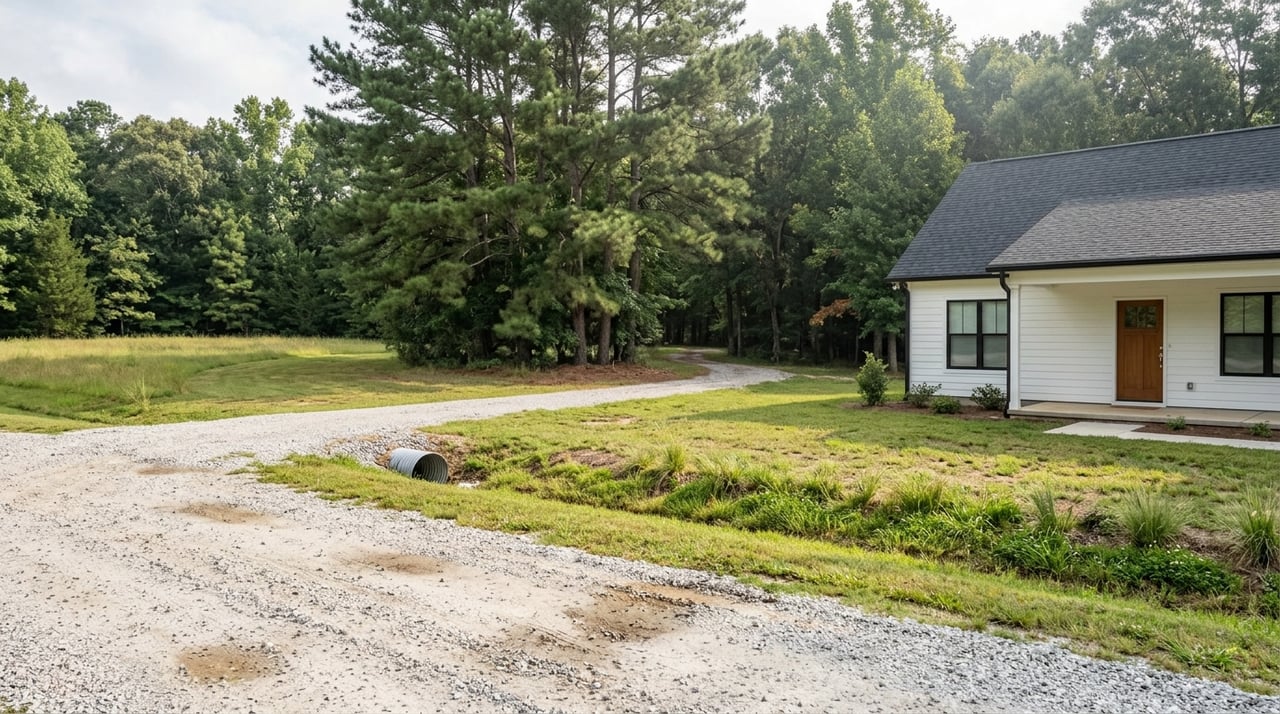
For two-lot splits, county guidance allows direct access from an existing road if the lots share a permanent deeded right-of-way that is at least 20 feet wide, with an all-weather gravel drive at least 12 feet wide and 3 inches deep that is passable by emergency vehicles. For three or more lots, the county requires a new permanent deeded 50-foot right-of-way, VDOT-compliant access, and roadway construction before building permits are issued.
In plain terms, access can become expensive quickly. If your proposed lots need a new road, upgraded entrance, or additional right-of-way work, those costs can change whether the split makes financial sense.
VDOT May Be Part of the Process Too
County approval is only one part of the picture. If your project involves work in state highway right-of-way, VDOT has a separate role.
VDOT says a land use permit is required for work in state right-of-way, including private entrances, commercial entrances, utilities, and surveying operations. Its private-entrance permit applies to access serving no more than two private residences or certain agricultural accesses.
If you are creating subdivision streets, VDOT says those streets are accepted for maintenance only when they meet state street-acceptance standards, the right-of-way is dedicated, and the locality requests acceptance. That is why access planning should happen early, not after the plat is already drafted.
Septic and Well Feasibility Often Decide the Outcome
In a rural county like King and Queen, septic and well feasibility can be the deciding factor. The county requires health department approval for the location of each lot’s well, primary drainfield, and reserve drainfield before final approval in family subdivisions.
Virginia law also allows the health department to accept private site evaluations and designs from a licensed onsite soil evaluator or a professional engineer working with one. Even so, the county notes that a site approval is not a guarantee that a later construction permit will be issued if conditions change.
That is a key point for both owners and buyers. A lot is far more marketable when septic and well locations have already been addressed in a realistic way.
Environmental Rules Can Shrink Your Options
Environmental constraints are another common reason a proposed split does not work as planned. If the project involves clearing, grading, excavating, or fill, the county’s environmental program says a land-disturbance permit is required for more than 2,500 square feet in the RMA and more than 10,000 square feet outside the RMA.
The county also warns that a 100-foot RPA buffer may apply where wetlands, streams, or other water bodies are present. On some tracts, that buffer can significantly reduce usable area and change where access roads, septic fields, or home sites can go.
This is why wetland and buffer issues should be reviewed before you assume a parcel can produce market-ready lots. A property line split is only valuable if the resulting lots can actually be used.
Family Subdivision Rules Deserve Extra Attention
Family subdivisions can be helpful, but they come with clear restrictions in King and Queen County. According to county materials, they apply only in the agricultural zoning district and allow only one sale or gift per immediate family member.
The county also caps the original parcel at seven total lots or parcels, including the residual lot, and requires the land to have been held for two years before division. In addition, the grantee must hold the lot for ten years before reselling, leasing, or gifting it, unless an exception applies.
The county says repeated one- and two-lot or family splits used to get around the ordinance are not allowed. If you are planning around estate transfers or long-term family ownership, these rules should be reviewed at the start.
Taxes and Value May Change After Recordation
Subdivision can affect tax treatment. Under Virginia law, when a tract is subdivided into recorded lots, each lot is separately assessed and shown on the land books, and the new assessment is made at fair market value as of January 1 of the next year after recordation.
That means the new lots will not necessarily carry the same acreage-based assessment approach as the original tract. It also means a split can change your holding costs over time.
Just as important, subdivision does not automatically create more value. In practical terms, value depends on whether the new lots are buildable, accessible, and easier to sell. If a split creates parcels that still need major road work, septic work, or environmental mitigation, buyers may discount them.
Heirs and Co-Owned Land Need Title Review First
If inherited property is involved, the first step should be confirming title, current recorded ownership, and deed language tied to access easements. That is especially important before paying for survey or engineering work.
The county’s application materials require current-owner information, deed references, access statements, and recorded affidavits on the plat. If ownership is unclear or access rights are not properly documented, the subdivision process can stall before it really begins.
For heirs, this is often the most important early due diligence item. A title review can save time, money, and family frustration later.
A Smart First-Step Checklist
Before you move ahead with subdividing land in King and Queen County, it helps to work through a simple checklist:
- Confirm which subdivision track applies to your parcel
- Check that taxes, fees, and owner compliance issues are current
- Review zoning district and lot standards
- Order a survey or updated plat with development details
- Evaluate road frontage, easements, and right-of-way needs
- Check septic, well, and drainfield feasibility
- Review wetlands, RPA buffers, and land-disturbance thresholds
- Verify title, deed references, and ownership if heirs are involved
- Estimate whether the resulting lots will be truly buildable and marketable
For many owners, the biggest mistake is assuming a large tract can be split without testing access, soils, and buildable area first. The strongest plans start with feasibility, not just acreage.
If you are weighing whether to subdivide, sell as-is, or hold for the future, practical guidance can make a big difference. David Berberich brings local market knowledge plus hands-on land and builder insight to help you think through what a property can realistically support and how it may play in the market.
FAQs
Where do you start when subdividing land in King and Queen County?
- Start with the county’s Planning & Zoning process and confirm with the Zoning Administrator which subdivision track applies to your parcel.
Do you need a survey to subdivide land in King and Queen County?
- Yes. County materials require signed and notarized plats or surveys, and the plat must show development details such as boundaries, setbacks, access, and other required information.
Can you subdivide land in King and Queen County using a private road?
- Sometimes. The parcel still needs to meet county access standards, including deeded right-of-way requirements, and VDOT requirements may apply if the access connects to state right-of-way.
Will subdividing land in King and Queen County increase property value?
- Not always. The added value depends on whether the new lots are buildable, accessible, and attractive to buyers in the local market.
What are the family subdivision rules in King and Queen County?
- Family subdivisions are limited to qualifying property in the agricultural zoning district and come with rules on lot counts, ownership duration, family transfers, and how long the grantee must hold the lot before reselling, leasing, or gifting it.
Can wetlands or buffers affect a land split in King and Queen County?
- Yes. Wetlands, Chesapeake Bay Resource Protection Areas, and possible 100-foot RPA buffers can reduce usable land area and limit where homesites, roads, and drainfields can go.